


Biosecurity pays price if rates cut, council warned

Cut rates too far and biosecurity risks will become real, Taranaki Regional Councillors have been warned.
TRC’s chief executive Steve Ruru has cautioned councillors they’d need to choose which biosecurity risks to relax their guard over, if funding shrinks.
“There are some trade-off decisions that need to be made,” he said.
“We are at a point where we need to let some biosecurity risk be realised within the funding constraints we have.”
“Particularly if you want to reduce rates, we can’t manage and control the wall.”
In February councillors decided it was too expensive to try and eradicate an infestation of invasive gold clams from a New Plymouth boating lake, pinning their hopes on a hunt for external funding.
Ruru’s caution came at Tuesday's council meeting as the council began preparations for its next ten-year plan.
The Government has abolished regional councils after 2028, but TRC remains legally bound to draw up a Long-Term Plan.
Chair Craig Williamson said the plan must set out TRC ’s work and priorities for whatever organisation inherits its roles.
“We need to absolutely continue with that process and lay out everything, all our cards and everything that's on the table,” he said.
District councils were struggling get their heads around what regional councils do.
The legacy of TRC’s work to date must be “core and fundamental to any future local government system that comes out of this region post-2028,” Williamson said.

Regional councils deal with resource development, consenting, and environmental protection including waterways and the coast.
Councillors unanimously agreed to include three iwi representatives in the Long-Term Plan talks, with speaking but not voting rights.
Te Tōpuni Ngārahu, the region’s joint iwi body, will choose who sits in on the planning process.
A report to Tuesday’s meeting recommended picking at least one of the six reps already sitting on the council’s two key committees.

TRC also adopted its Annual Plan – the budget for 2026-27.
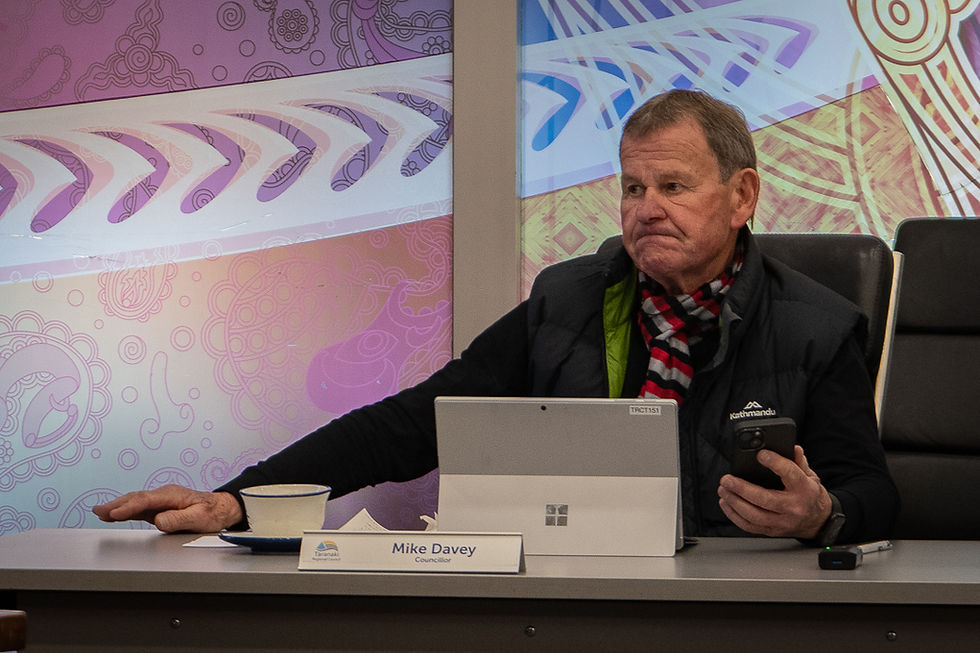
Through workshops and meetings the council had settled on a rates rise of 9.9 percent, but councillors Mike Davey and Alan Jamieson voted against the plan.
Davey said councillors should tell staff to follow Government directives for lower rates rises.
“We're in governance, we're not in management.
“We can suggest a rate increase of say … four or five percent, that's up to Steve then go back and do the numbers.”
Ruru advised that would mean revoking the decision the majority of councillors had just made to adopt the Annual Plan.
Williamson ruled it too late for any wholesale changes, saying Davey could aim for future budget cuts in the Long-Term Plan process.
Staff said the 9.9 percent rates rise would be just over $40 a year for the average household, or 77c a week.
nā Craig Ashworth craig@tekorimako.co.nz
LDR is local body journalism hosted by Te Korimako and funded by Te Reo Irirangi o Aotearoa and Irirangi te Motu


Comments